




 7 minutes
 Share
ShareBest Bitcoin Wallets of 2025 – Secure Ways to Store BTC
Bitcoin remains the most trusted digital asset worldwide, and choosing the right Bitcoin wallet in 2025 is more important than ever. With security threats evolving and user needs becoming more diverse, wallets now differ not only by features but also by the type of protection and convenience they offer.
Whether someone wants long-term BTC storage, daily spending access, or a flexible combination of both, the wallet they use determines how safely their Bitcoin is held. The market in 2025 offers more refined, secure, and user-friendly solutions than previous years, giving holders complete control when protecting their assets.
This guide highlights what makes a wallet truly strong, the types available, and which Bitcoin wallets stand out this year.
Meanwhile, learn more about What is Bitcoin Wallet and how does it work.
What Makes a Great Bitcoin Wallet in 2025
Choosing a Bitcoin wallet is not just about where BTC is stored - it’s about balancing security, usability, and long-term ownership. The best wallets in 2025 share several core characteristics that help protect funds while remaining accessible for everyday use. Key factors to evaluate include:
- Strong security foundations and private key ownership
- Support for Bitcoin-only storage (no noise, no distractions)
- Reliable backup and recovery mechanisms (seed phrase integrity)
- Cold storage or offline access for long-term protection
- Compatibility with desktop, mobile, and hardware devices
- Low fees + transparent transaction control
- Practical availability for users in Georgia and Europe
- Lightning Network capability for fast BTC payments (optional but valuable)
These criteria help beginners and advanced holders find the most suitable wallet based on safety needs, usage habits, and storage strategy.
Types of Bitcoin Wallets – Hot vs Cold vs Hybrid
Bitcoin wallets generally fall into three main categories: hot, cold, and hybrid usage strategies.
Each offers different levels of security, accessibility, and convenience depending on how often a user interacts with Bitcoin.
Hot Wallets (Software/Mobile/Web)
Hot wallets are connected to the internet, making them easy for everyday BTC access, spending, and transfers. They are ideal for beginners and frequent users who want quick interaction with Bitcoin without hardware barriers.
Pros:
- Fast access for transactions
- Simple setup and beginner-friendly
- Available on mobile, desktop, and browser
- No physical device required
Cons:
- Less secure than offline wallets
- Vulnerable to malware or phishing attempts
- Not ideal for storing large BTC holdings
- Requires careful password/seed protection
Cold Wallets (Hardware/Offline Storage)
Cold wallets store Bitcoin offline, providing the highest level of protection. Because private keys never touch the internet, these devices are considered the most secure way to hold BTC - especially for long-term storage or large balances.
Pros:
- Maximum security + offline private keys
- Ideal for long-term Bitcoin storage
- Resistant to hacking, malware, and online theft
- Full self-custody and asset control
Cons:
- Requires physical device purchase
- Not ideal for rapid, daily BTC spending
- Setup may feel complex for beginners
- Risk of losing BTC if recovery phrase is mishandled
Hybrid Strategy – Hot + Cold Combined
Many Bitcoin holders in 2025 prefer a split method: cold storage for the majority of funds, and a hot wallet for daily use. This approach blends security with convenience and is widely considered the most balanced structure for real BTC users.
Pros:
- Best of both worlds - secure + accessible
- Cold wallet protects savings, hot wallet handles daily use
- Reduces risk exposure while remaining functional
- Flexible for spending, investing, and holding
Cons:
- Management split between two wallets
- Requires discipline in transfer and storage habits
- Higher responsibility due to dual recovery backups
TOP Recommended Bitcoin Wallets in 2025 – By Use Case
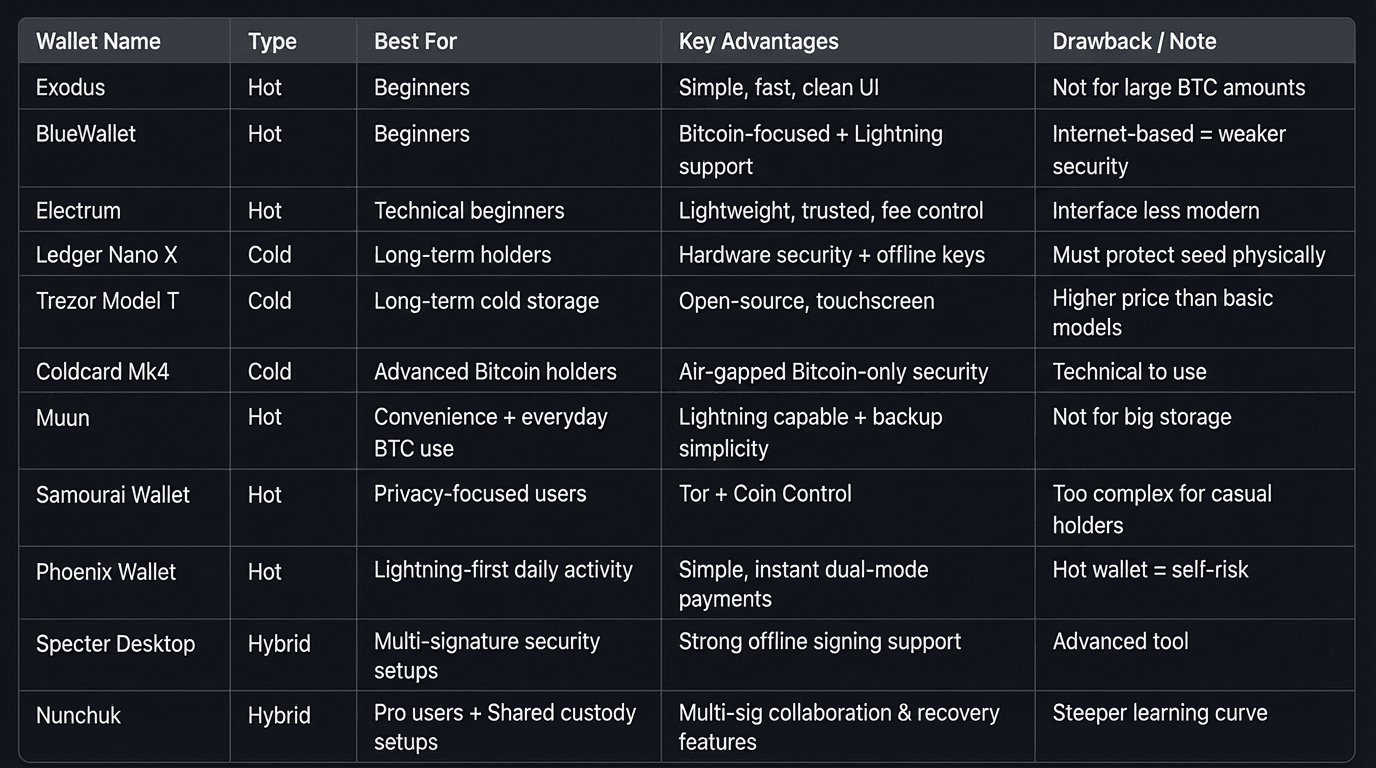
The best Bitcoin wallet depends on how a user plans to store and interact with their BTC. Some wallets are built for simplicity, some for maximum security, and others for users who want full control. Below are the strongest choices across each category, based on reliability, reputation, and Bitcoin-focused functionality.
Best for Beginners
Designed for simplicity and fast setup - ideal for first-time Bitcoin owners:
- Exodus Wallet - Software (Hot)
- Advantages: Easy interface, strong design, supports BTC lightning, fast to start
- Drawbacks: Hot wallet = less secure for large balances
- BlueWallet - Mobile (Hot)
- Advantages: BTC-focused, lightning support, simple backup, beginner-friendly
- Drawbacks: Software-stored keys require strict security habits
- Electrum - Desktop (Hot)
- Advantages: Lightweight, trusted since 2011, customizable network fees
- Drawbacks: Interface feels technical for some users
Best for Long-Term Cold Storage / Maximum Security
- Ledger Nano X - Hardware (Cold)
- Advantages: Offline key storage, Bluetooth capability, secure element chip
- Drawbacks: Must purchase device; seed must be safeguarded properly
- Trezor Model T - Hardware (Cold)
- Advantages: Open-source firmware, touchscreen, Bitcoin self-custody
- Drawbacks: Higher price; requires learning curve for new users
- Coldcard Mk4 - Hardware (Cold, Bitcoin-maxi-oriented)
- Advantages: Purpose-built for BTC security, air-gapped signing, PIN-based
- Drawbacks: Technical - recommended for advanced security-thinking holders
Best for Convenience-First Bitcoin Users
For everyday payments, withdrawals, or fast transfers:
- Muun Wallet - Mobile (Hot / Lightning-Ready)
- Advantages: Supports instant Lightning payments, clean UI, backup simplicity
- Drawbacks: Internet-connected → not ideal for large BTC stores
- Samourai Wallet - Mobile (Hot)
- Advantages: Strong privacy features, coin control, Tor routing
- Drawbacks: Best suited to users who understand UTXO management
- Phoenix Wallet - Mobile (Hot)
- Advantages: One-wallet LN + On-chain, very easy to operate
- Drawbacks: Custody-risk if seed is lost or unprotected
Best for Technical Bitcoin Holders
For users who want advanced controls, signing, multi-stage security
- Specter Desktop - Multi-sig / Hardware-compatible
- Advantages: Multi-wallet management, full key control, offline signing
- Drawbacks: Requires more technical experience & hardware combo use
- Nunchuk Wallet - Multi-sig Security Suite
- Advantages: Best-in-class collaborative signing, strong security flows
- Drawbacks: Complexity not ideal for beginners
Security Best Practices for Wallet Use
Even the best Bitcoin wallet becomes unsafe if not used correctly. Strong tools require strong habits, and every BTC holder should follow key protection principles - especially in 2025, where threats are more advanced than ever. Important wallet security rules include:
- Seed phrase must be written and stored offline - never photographed or typed into cloud storage
- Cold storage for long-term BTC holdings
- Hot wallets only for daily use or small balances
- Use hardware wallets with passphrase + PIN protection
- Keep multiple backups of recovery phrases (in separate secure locations)
- Avoid browser wallet extensions unless fully trusted
- Always verify download sources - no unofficial apps or APKs
- Turn on encrypted PIN/biometric access for mobile wallets
- Beware phishing - never enter wallet seed on any website
- Firmware should be kept updated, but only from official vendor links
Bitcoin self-custody means control - but control comes with responsibility. Security is not optional, it is a survival requirement.
How to Choose the Right Wallet
There is no universal “best” Bitcoin wallet - only the best wallet for a specific user, storage strategy, and security expectation. Beginners often prefer hot wallets for everyday use, while long-term holders rely on cold storage for complete protection. Some choose a hybrid approach, splitting BTC between convenience and maximum security.
In 2025, Bitcoin wallets are more advanced, accessible, and secure than ever, making self-custody achievable for both newcomers and experienced users. The strongest approach is always built on awareness: choose a wallet that aligns with your habits, protect your recovery phrase, and treat your Bitcoin holdings as assets worth safeguarding. A well-chosen wallet is more than storage, it is ownership, independence, and the foundation of a secure future in crypto.